
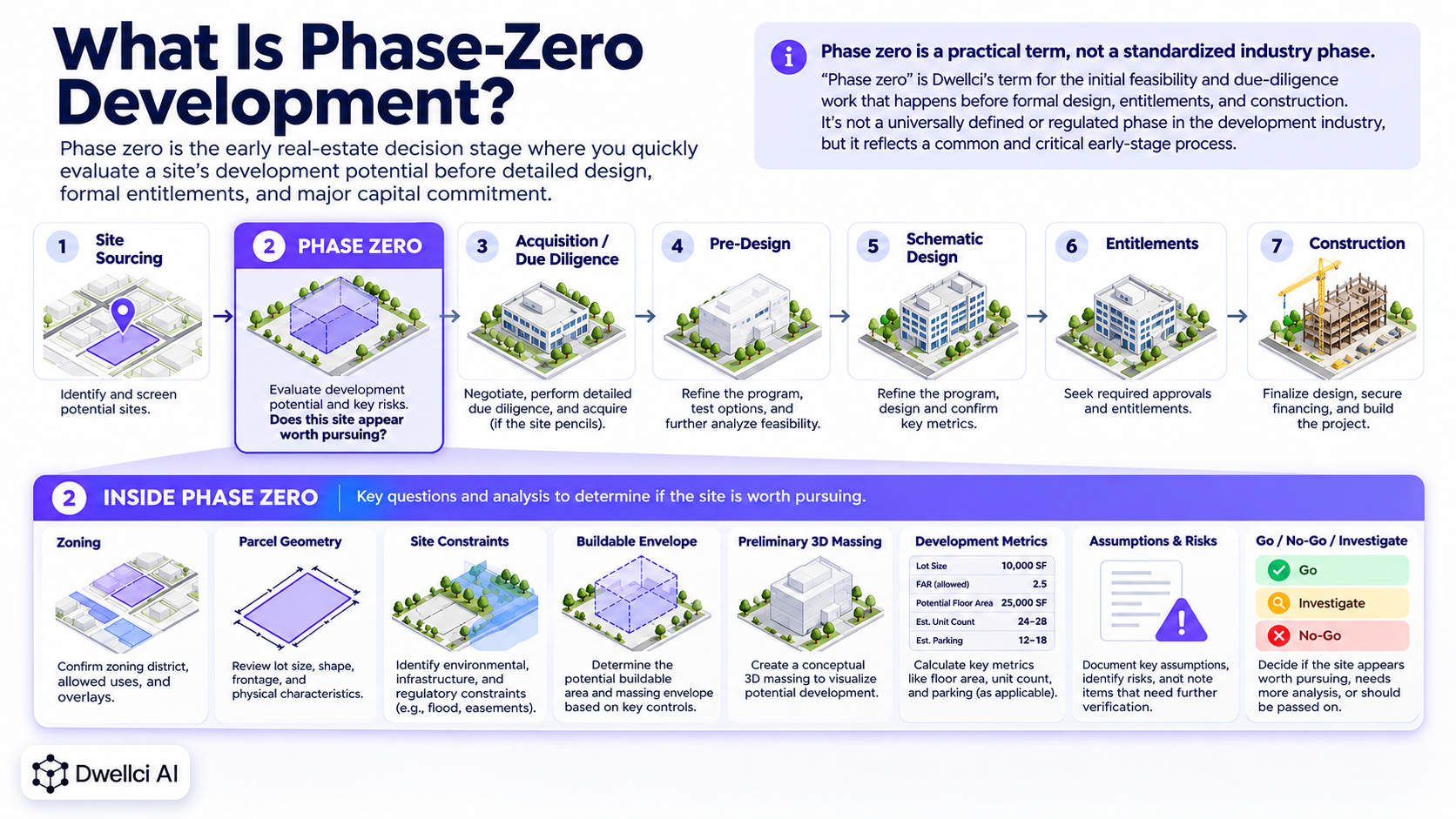
Phase-zero development is Dwellci's practical term for the earliest stage of real estate development: the work that happens before detailed design and before a developer commits significant capital to a site. It focuses on answering whether a property appears capable of supporting the intended project, what controls that answer, and which uncertainties still need deeper diligence.
The term is not a universal industry-standard project phase. It overlaps with parts of what many organizations call predevelopment or pre-design. Dwellci uses “phase zero” to describe the narrower decision layer that comes first: site screening, zoning, parcel constraints, buildable potential, preliminary massing, and early go/no-go decisions.
The central question is:
“Before we spend heavily on design, consultants, entitlements, or closing, does this site appear worth pursuing?”
Phase-zero development is the earliest feasibility and site-screening stage of a real estate project.
It typically includes:
The goal is not to finish the project. The goal is to make the next decision with better information.
Traditional project frameworks often begin with predevelopment, pre-design, or schematic design.
Those phases can include substantial consultant work, programming, engineering studies, cost analysis, financial modeling, and design development.
UC's current Facilities Manual, for example, describes pre-design as the period before design activities begin and notes that it can include feasibility studies, site analysis, construction-cost analysis, programming, geotechnical work, hydrology studies, land and utility surveys, and environmental due diligence. UC's Pre-Design Phase guidance illustrates how broad formal pre-design can become.
Dwellci uses phase zero for the earlier decision gate that asks whether the site should advance far enough to justify that broader work.
Phase zero overlaps with predevelopment but is narrower in purpose.
Housing Toolbox describes predevelopment as including preliminary site evaluation, review of regulations, preliminary engineering and conceptual site design, and preliminary financial feasibility. Its predevelopment guidance shows how site and financial feasibility become progressively more detailed before development moves forward.
Phase zero sits at the front edge of that process.
It helps determine which properties or scenarios deserve the time and expense of full predevelopment.
Pre-design can involve formal programming, consultant studies, site investigations, budget analysis, and multiple design alternatives.
Phase zero comes earlier and is more focused on acquisition and feasibility screening.
A useful distinction is:
AIA resources also recognize pre-design/site analysis as occurring before schematic design in a typical project sequence. AIA's project-phase framework provides that broader context.
A simplified development sequence is:
The exact sequence varies by project and jurisdiction, but the principle is consistent: the earlier a developer can reject a weak opportunity, the less capital is wasted downstream.

Phase-zero analysis should begin with a question about the project—not just the property.
Define the intended use or strategy, such as:
Where useful, establish approximate assumptions for unit size, parking strategy, ground-floor uses, building type, or target yield.
The same site can be attractive for one program and weak for another.
Next, confirm the property being analyzed and the regulatory starting point.
That includes:
This is the point where a basic zoning lookup becomes useful—but it is not yet a feasibility conclusion.
See Zoning Lookup vs. Development Feasibility Analysis for that distinction.
Phase zero then tests the controls that shape the site's development envelope.
Typical inputs include:
These controls must be tested together.
For a combined explanation, see FAR, Height, Setbacks & Lot Coverage Explained.
Base zoning is only one layer of development potential.
Phase-zero screening should identify major conditions such as:
The purpose is not to fully resolve every condition at this stage.
It is to identify which issues can materially change the development thesis and therefore deserve deeper verification.
See Zoning Overlays & Site Constraints for the full framework.
Once the rules and major constraints are known, phase zero should translate them into geometry.
A preliminary buildable envelope shows where development may potentially occur after dimensional controls are applied.
This is more useful than a list of zoning values because it begins to answer whether the rules can physically work together on the parcel.
For more detail, see What Is a Buildable Envelope?.
A buildable envelope is still only a regulatory volume.
A phase-zero massing test places a conceptual development scenario inside that volume to estimate whether the intended program appears plausible.
Useful questions include:
The massing is not final architecture. It is a decision-support model.
Phase zero should turn the massing into measurable outputs.
Typical metrics include:
These numbers make it easier to compare opportunities and connect site feasibility to acquisition underwriting.
Phase-zero analysis should make uncertainty visible rather than hiding it.
A useful classification is:
This prevents an early assumption from silently becoming an investment fact.
For a deeper diligence framework, see Zoning Due Diligence Checklist for Developers.
Phase zero becomes especially valuable when a developer is screening several acquisition opportunities.
Instead of comparing sites by headline FAR or asking price, compare them using the same development assumptions and outputs:
See How to Compare Development Sites Before Acquisition for a full comparison framework.

Phase zero is not a full financial feasibility study, but it should produce enough development information to support an early economic screen.
A developer may test:
The purpose is not to finalize the pro forma.
It is to avoid advancing a physically plausible site that is obviously inconsistent with the acquisition thesis.
Phase zero should end with a decision gate.
A useful outcome might be:
This decision is the main purpose of the phase-zero workflow.
A strong phase-zero output should be compact but decision-ready.
Useful deliverables include:
See What Should a Real Estate Feasibility Report Include? for the reporting structure.

Phase zero is intentionally early and should not be presented as a substitute for:
Those services may still be required.
Phase zero helps determine whether the opportunity appears worth taking into those deeper workstreams.
For smaller development teams, every consultant engagement and acquisition process consumes meaningful time and capital.
A weak site discovered late can create:
Phase zero moves the feasibility question earlier so resources can be concentrated on the sites with the strongest development thesis.
Early development decisions often require information from many sources:
The challenge is not simply finding the data.
It is converting that information into one coherent answer about development potential.
That is the core function of phase zero.
Feasibility software can make that early workflow more repeatable while still preserving professional verification where judgment matters. See Manual Site Feasibility vs. Feasibility Software.
EPA's brownfield redevelopment framework describes predevelopment as the stage where potential reuse is identified and assessed, due diligence is performed, property access is obtained for assessments, and potential costs and funding sources are identified before a party decides whether to take control of the property and continue. EPA's site-reuse planning guidance illustrates the broader predevelopment decision process.
Dwellci's phase-zero framing is intentionally more focused: it is the early site-feasibility layer within that broader world of predevelopment.
Ideally, phase zero happens:
The earlier the analysis is performed, the more useful it is as a filtering tool.
Dwellci AI is built specifically around this earliest development decision.
The platform combines parcel intelligence, zoning analysis, site constraints, zoning-backed 3D massing, and development metrics so developers can move from:
“This parcel looks interesting.”
to:
“Here is what it appears capable of supporting, what controls that outcome, and what still needs to be verified.”
The goal is to make better development decisions before committing significant capital to the wrong site.
No. The term is not a universally standardized industry phase. Dwellci uses it as a practical label for the earliest site-screening and feasibility work that occurs before detailed design and major capital commitment. In other frameworks, parts of this work may fall under predevelopment or pre-design.
Not exactly. Predevelopment can include a much broader range of activities such as engineering studies, programming, environmental diligence, surveys, cost analysis, and financial feasibility. Phase zero focuses on the earliest development-potential and go/no-go decision.
It can include a preliminary financial screen, such as land basis per achievable square foot or unit, but it is not a substitute for a full development pro forma and financial feasibility study.
No. Phase-zero massing is conceptual decision support, not architectural design. Architects and other professionals remain essential as a project advances.
A useful output is a concise feasibility package showing the site, zoning, constraints, buildable envelope, preliminary massing, development metrics, assumptions, risks, evidence, and next steps.