

Zoning due diligence is the process of verifying the land-use rules, dimensional controls, approvals, and existing legal conditions that affect a property before a developer relies on its development potential. A zoning lookup is only the starting point. Good diligence confirms what rules actually apply, whether the proposed use appears permitted, how much can fit, and which issues still require professional or jurisdictional verification.
For an acquisition team, the practical question is:
“What zoning facts are reliable enough to use in the investment decision, and what still needs to be verified before closing?”
A practical zoning due diligence review should verify:
The goal is not to eliminate every possible project risk before acquisition. It is to identify the zoning facts that materially affect value and separate verified conditions from assumptions.
Before reviewing zoning, confirm that the address, parcel identifier, lot boundaries, and ownership records refer to the same property.
This sounds basic, but redevelopment sites can involve:
A zoning conclusion applied to the wrong parcel geometry can invalidate every calculation that follows.
For early feasibility, parcel dimensions should be treated as a critical input rather than a background detail.
An online map or property portal can be useful for screening, but acquisition diligence should verify the authoritative zoning source for the jurisdiction.
New York City's Zoning Resolution, for example, consists of zoning maps that establish mapped districts and zoning text that contains the applicable regulations. The current online Zoning Resolution includes 126 zoning maps and separate articles governing use, bulk, parking, and special-purpose districts. NYC's Zoning Resolution illustrates why a district label is only the first step.
If a property sits near a zoning boundary, do not rely on a simplified map display alone. Boundary location can materially change permitted use, FAR, bulk, or parking requirements.
Base zoning may not be the only regulatory layer that applies.
A property may also be affected by:
These layers can modify the base district's use, FAR, height, parking, streetscape, or approval requirements.
For a deeper explanation of how overlays differ from parcel-specific constraints, see Zoning Overlays & Site Constraints: How They Affect Development Potential.
NYC's Zoning Resolution, for example, dedicates Articles VIII through XIV to Special Purpose Districts, each of which can modify otherwise applicable rules. Article IX provides examples of such districts.
Do not assume that a zoning district's general description is enough to establish that a specific project is allowed.
Confirm:
Use classification can be one of the most important acquisition risks because a site that supports the desired bulk may still not permit the intended program without additional approvals.
Confirm the FAR or other density control that applies to the intended use—not merely the highest number shown in a zoning summary.
Review:
Also confirm the local definition of floor area. Gross building area and zoning floor area are not necessarily the same.
For a deeper explanation, see Floor Area Ratio (FAR): What Developers Need to Know.
Dimensional controls determine whether theoretical floor area can physically fit on the site.
Confirm:
These controls should be tested together, not reviewed as isolated numbers.
See How Setbacks Affect Development Yield, FAR vs. Lot Coverage, and What Is a Buildable Envelope? for the geometric implications.
Parking and loading requirements can consume substantial site area or affect project economics, particularly on small or constrained sites.
Depending on the jurisdiction and use, review:
Do not assume that a building fits simply because the zoning envelope fits.
Access, loading, and circulation may become the controlling site constraint.
For a property with an existing building, zoning diligence should include the legal status of what is already there.
In New York City, the Certificate of Occupancy states the legal use and/or permitted occupancy of a building. DOB's Building Information System and DOB NOW Public Portal can also provide records of permits, applications, complaints, violations, and occupancy information. NYC DOB's Certificate of Occupancy guidance and building-data tools show the types of records that can matter.
This can be especially important for adaptive reuse, change-of-use, or redevelopment projects where the existing condition affects the entitlement path.
An existing use or structure can be legal even if it would not comply with today's zoning rules.
That does not mean the condition can automatically be enlarged, reconstructed, changed, or reused without limitation.
New York City's Zoning Resolution specifically distinguishes non-conforming uses and non-complying buildings and directs such conditions to separate regulations. The Resolution's general provisions note that Article V may apply when an existing use or building is non-conforming or non-complying.
For acquisition diligence, determine whether the proposed plan depends on preserving, modifying, or replacing an existing legal nonconformity.
A property's current configuration or use may rely on an approval that is not obvious from the base zoning map.
Review whether the site is subject to:
These approvals may contain conditions, expiration dates, operating restrictions, design requirements, or limitations on future modifications.
NYC's Zoning Resolution, for example, provides separate procedures for special permits that can modify specified use or bulk regulations when required findings are met. Article VII, Chapter 4 shows why discretionary approvals need to be reviewed independently from base zoning.
Open building or zoning enforcement issues may affect closing, financing, redevelopment timing, or the ability to obtain future approvals.
In NYC, DOB states that public building history can include violations, permits, complaints, applications, and inspections. It also notes that active violations can interfere with new or amended Certificates of Occupancy or Letters of Completion. DOB's building-history guidance is one example of the records developers may need to review.
In other jurisdictions, equivalent planning, building, code-enforcement, and permit databases should be checked.
Zoning is not static.
Review whether the property is affected by:
This is particularly important when a deal depends on a recently changed FAR, use, parking, or height rule.
For example, NYC's current online Zoning Resolution publishes recently adopted amendments and the date through which approved text changes are incorporated. The live Zoning Resolution should therefore be checked rather than relying solely on an older summary.
Zoning due diligence is necessary, but it is not the entire acquisition diligence process.
Separate reviews may still be needed for:
EPA's All Appropriate Inquiries framework is one example of a distinct environmental due-diligence process. EPA describes AAI as evaluating a property's environmental conditions and potential contamination liability before acquisition. EPA's AAI guidance illustrates why environmental diligence should not be confused with zoning review.
Similarly, FEMA's Flood Map Service Center is the official public source for National Flood Insurance Program flood-hazard information and may be relevant to site screening even though flood mapping is not the same thing as base zoning. FEMA's Flood Map Service Center is the appropriate starting point for that layer.

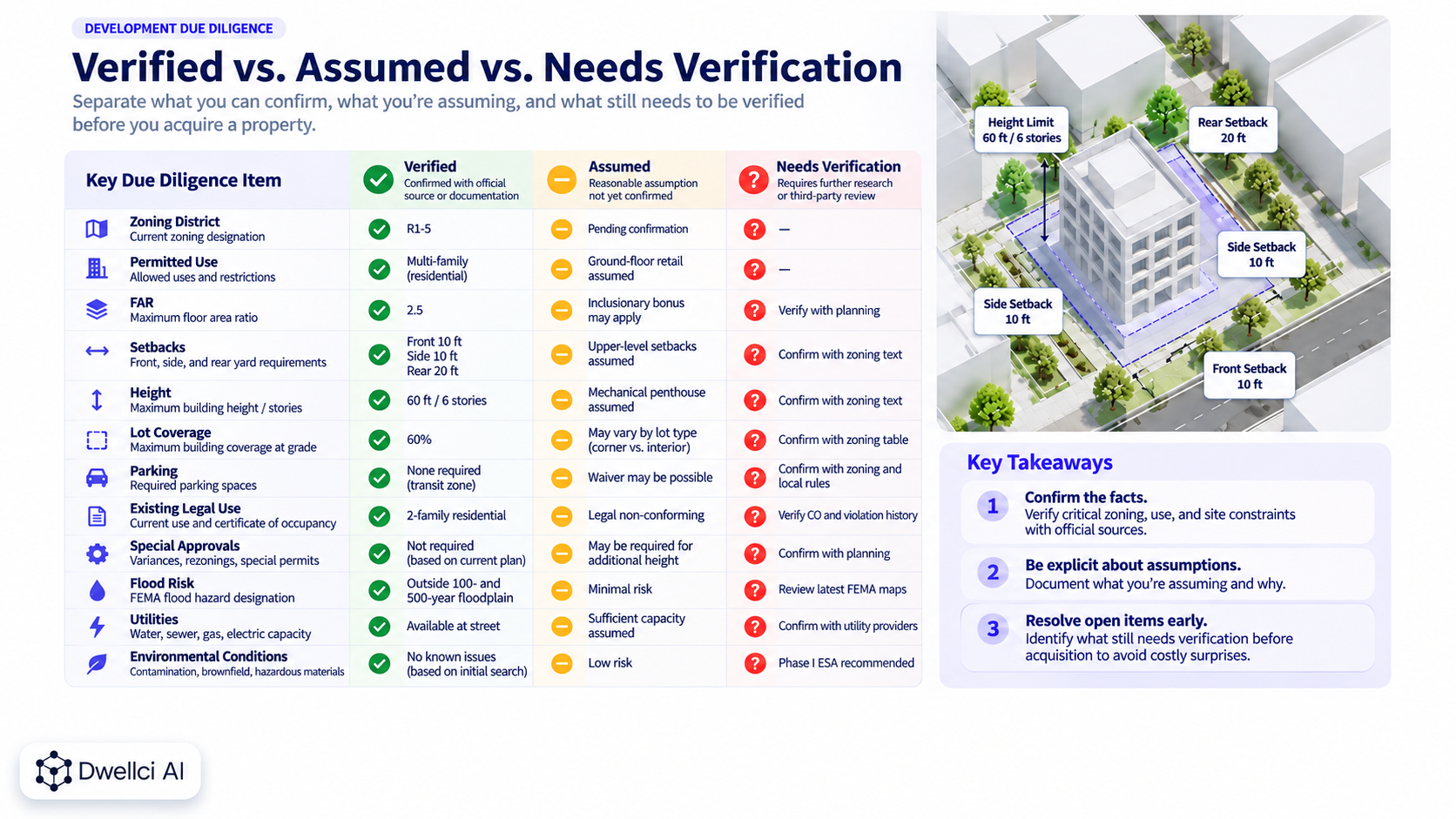
A strong diligence process should make uncertainty visible.
For each major development assumption, classify it as:
This prevents a preliminary assumption from quietly becoming an investment fact.
It also creates a clear diligence agenda for the acquisition team.
A checklist is useful, but the development decision still requires geometry.
Once the zoning inputs are assembled, test them on the actual parcel:
This is the step that converts zoning research into development feasibility.
Common zoning-diligence red flags include:
Any one of these does not automatically kill a deal. It means the project should not be priced as though the issue is already resolved.
Zoning diligence should begin during initial site screening and become more rigorous as the acquisition moves toward commitment.
A practical sequence is:

For a broader site-acquisition process, see How to Evaluate a Development Site Before Acquisition.
Dwellci AI is designed to help development teams move from parcel and zoning information to an earlier, more structured feasibility view.
The platform combines parcel intelligence, zoning analysis, site constraints, and zoning-backed 3D massing so teams can identify what appears buildable, which zoning controls are driving the result, and which assumptions still need professional verification.
The goal is not to replace zoning counsel, architects, engineers, surveyors, environmental professionals, or agency review.
It is to help developers screen opportunities earlier and focus deeper diligence on the sites that justify the time and capital.
Zoning due diligence is the process of verifying the zoning rules, approvals, legal conditions, and dimensional controls that affect a property before relying on its development potential in an acquisition or investment decision.
Not necessarily. A zoning report can be an important input, but a development decision may also require parcel verification, survey/title review, legal-use records, entitlement review, site constraints, environmental diligence, engineering, and a site-specific feasibility analysis.
The appropriate team depends on the deal and jurisdiction. Zoning counsel, architects, land-use planners, surveyors, engineers, environmental professionals, and local agencies may all be involved in verifying different parts of the diligence.
One of the biggest mistakes is treating a zoning district or headline FAR as the development answer without testing use, dimensional controls, overlays, approvals, existing legal conditions, and parcel-specific geometry.
At least a preliminary zoning and feasibility screen should usually happen before a developer relies heavily on a site's development potential. More detailed verification can continue during contract diligence, depending on the transaction structure and risk tolerance.