
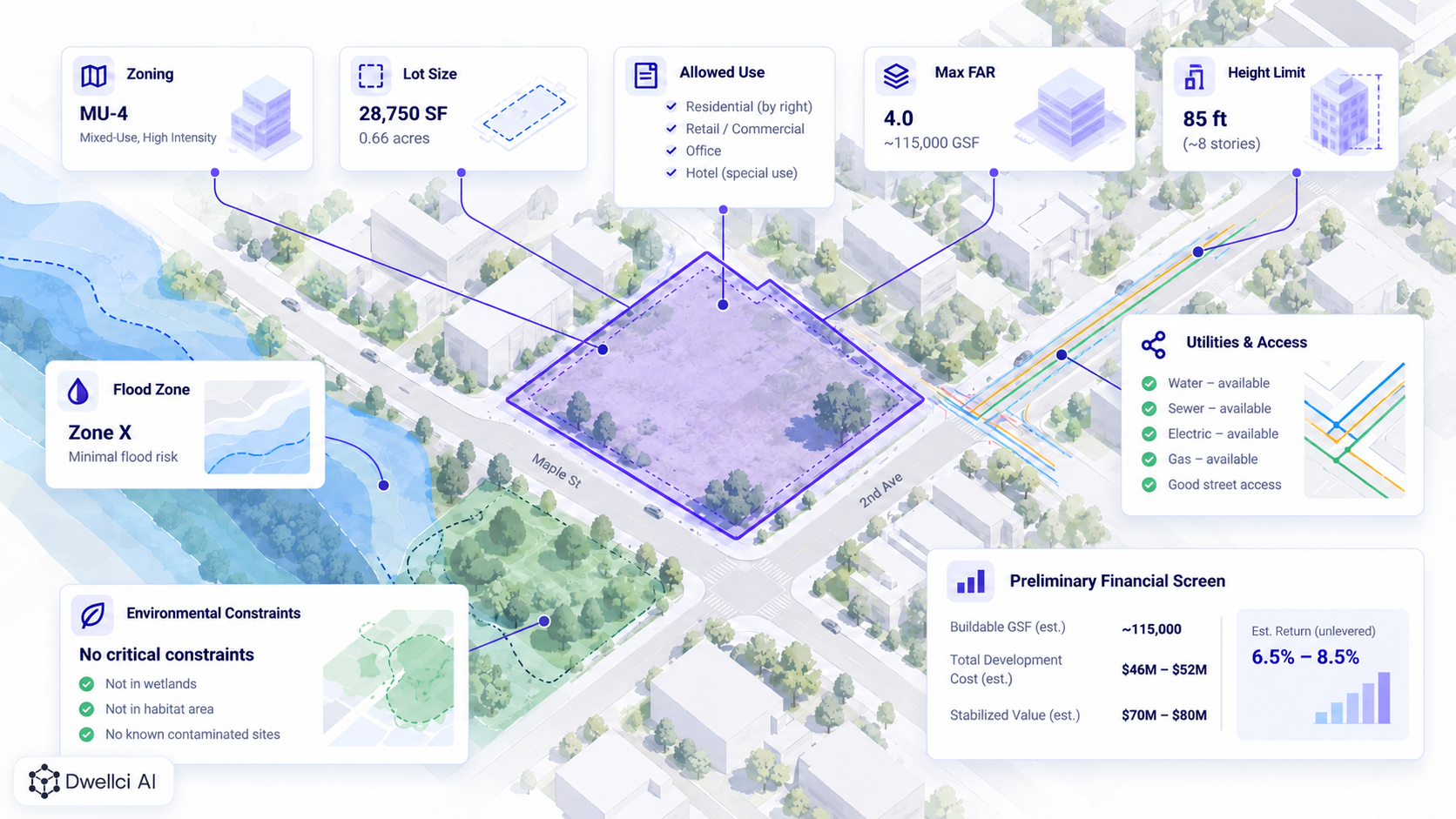
A development site should be evaluated before acquisition by testing whether the property can support the intended project from a regulatory, physical, environmental, infrastructure, and economic standpoint. The goal is not to eliminate every unknown before closing. It is to identify the assumptions and risks that could materially change the site's value or development potential.
For developers and acquisition teams, the central question is simple:
Does this property deserve more time, capital, and due diligence—or should we move on?
A disciplined early-stage review helps answer that question before design and professional diligence become expensive.
Real estate acquisition decisions are often made under time pressure. A property may have an attractive asking price, a strong location, or a zoning district that appears favorable. But those signals do not necessarily tell you what can actually be developed.
The earlier a team identifies a major constraint, the more choices it has. It can adjust the development program, renegotiate assumptions, investigate a specific issue, or decide not to pursue the opportunity.
That makes early site evaluation a screening and risk-management exercise.
EPA's redevelopment guidance describes due diligence as the process of identifying property characteristics that may affect transfer or reuse, including zoning, potential liens, encroachments, building conditions, and environmental issues. EPA's Reuse Assessment guidance provides a useful overview of these considerations.
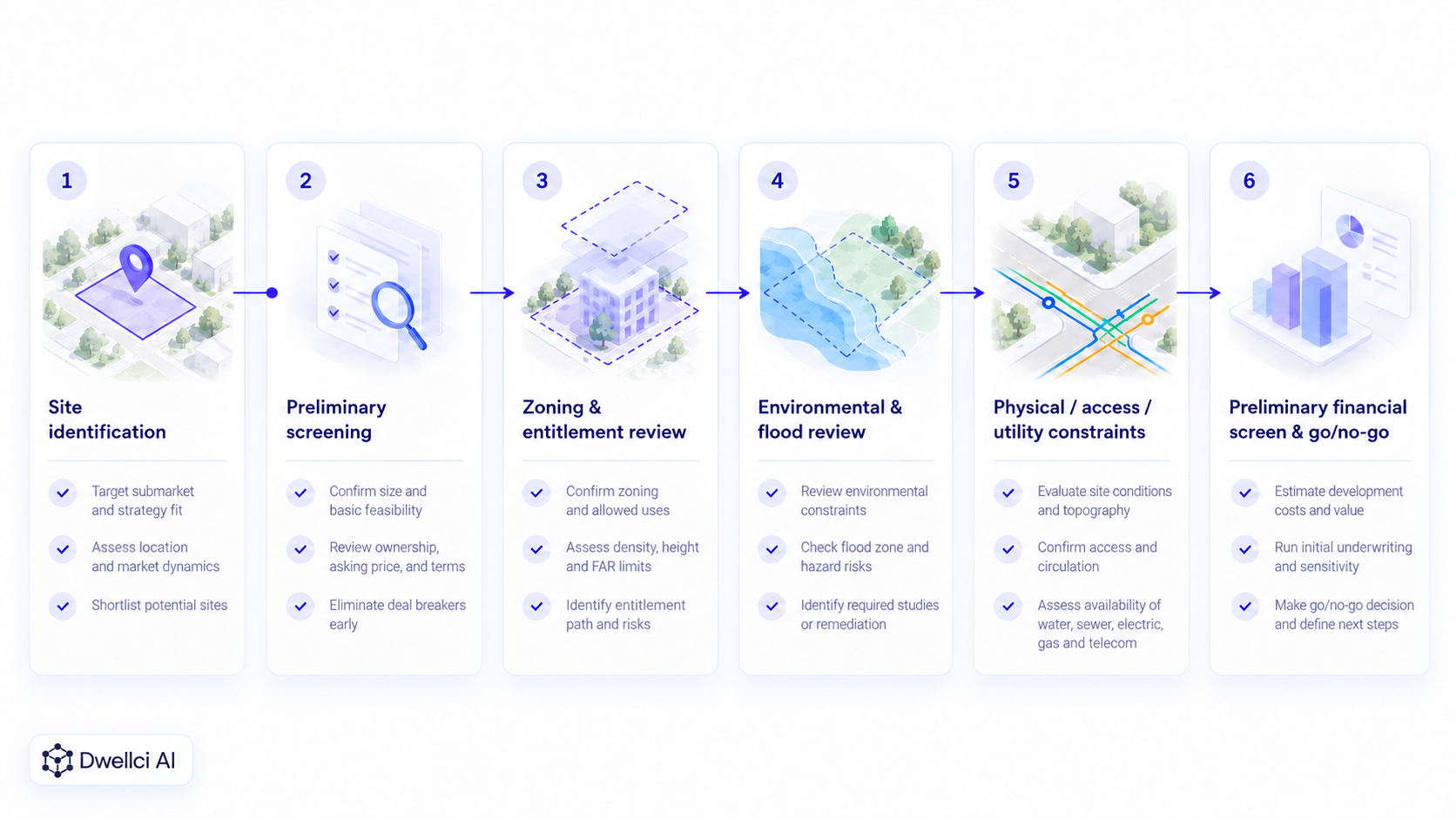
Before evaluating the property, define what you are trying to build.
The same parcel may be attractive for one development program and unsuitable for another. A feasibility review becomes much more useful when it is tied to a clear development thesis.
At minimum, establish preliminary assumptions for:
These assumptions do not need to be final. They provide a benchmark against which the site can be tested.
Start with the property itself.
Confirm parcel boundaries, lot area, dimensions, frontage, ownership records, existing improvements, and access conditions. Parcel geometry matters because a site with sufficient area on paper may still be difficult to develop if it is unusually narrow, irregularly shaped, landlocked, or constrained by existing conditions.
Early screening should also flag obvious discrepancies between marketing materials and public records.
The objective is to establish a reliable base parcel before applying zoning and development assumptions.
Next, determine the applicable zoning framework.
That usually means identifying the zoning district and reviewing whether the intended use is permitted, conditional, special-permit dependent, or prohibited. Depending on the jurisdiction, overlays, special districts, planned developments, historic controls, or other mapped conditions may also affect the site.
A zoning designation alone is not enough. The review should identify the dimensional and use regulations that materially affect the proposed development.
This is the difference between a zoning lookup and a site feasibility analysis: the first identifies rules, while the second asks what those rules mean for a specific site and development scenario.
Once the regulatory framework is understood, test how the major dimensional controls work together.
Common factors include:
These controls can interact in ways that materially reduce theoretical development capacity.
For example, a property may permit enough FAR for a desired program but still have a smaller usable building footprint because of setbacks or lot-coverage limits. A height limit can prevent the remaining floor area from being stacked vertically.
This is why early acquisition screening should move beyond isolated zoning values and test a plausible buildable envelope.
For a deeper breakdown of the controls that shape buildable potential, see What Can I Build on This Property? 7 Factors That Determine Development Potential.
Zoning is only one layer of development risk.
Flood exposure, wetlands, steep topography, drainage, existing structures, easements, contamination risk, and other site conditions may affect developable area or trigger additional professional review.
In its RE-Powering guidance for contaminated or formerly contaminated sites, EPA notes that conditions such as contamination, topography, regulated flood zones, and parcel dimensions can affect developable area and project viability. EPA's Site Conditions and Feasibility guidance illustrates why these issues should be identified early.
Environmental due diligence becomes particularly important when historical uses or other conditions create potential contamination concerns. EPA's All Appropriate Inquiries framework establishes standards for evaluating environmental conditions and potential liability in certain property acquisitions. EPA explains the AAI process here.
Early screening is not a substitute for a Phase I Environmental Site Assessment or other professional work. Its purpose is to identify where deeper investigation may be needed.
A developable zoning envelope does not guarantee a practical development site.
Consider how the property connects to the surrounding infrastructure. Questions may include:
At the screening stage, the goal is not to complete engineering design. It is to identify infrastructure assumptions that could later change the project's feasibility.
Flood risk can affect development standards, insurance, financing, design, and usable site area.
FEMA's Flood Map Service Center is the official public source for flood-hazard information used in the National Flood Insurance Program. FEMA's Flood Map Service Center should be part of a deeper flood-risk review when a site may be affected.
Other hazards vary by location and may include wildfire exposure, seismic conditions, coastal regulations, erosion, or locally mapped environmental constraints.
The point is not to assume every mapped condition makes development impossible. It is to identify conditions early enough to price, investigate, and manage them.
A useful acquisition review should ultimately produce something more actionable than a list of rules.
Translate the information into a preliminary development scenario.
That may include:
This step connects property data and zoning rules to the actual acquisition decision.
One of the most valuable outputs of early feasibility is a clear list of what is known, what is assumed, and what still requires verification.
For example:
This prevents preliminary analysis from being mistaken for final professional due diligence.
Developers rarely evaluate opportunities in isolation.
A consistent screening framework makes it easier to compare multiple sites based on more than asking price or raw acreage.
Useful comparison metrics may include:
A site with slightly less theoretical density may still be the better acquisition if it has a cleaner entitlement path, fewer physical constraints, and a more efficient building envelope.
A site can be physically developable and still be a poor acquisition. Before advancing, compare the site's apparent development capacity with preliminary assumptions for land basis, construction and soft costs, financing, rents or sale values, schedule, and contingency.
This does not require a final pro forma at the screening stage. The purpose is to test whether the opportunity remains plausible after the major site constraints identified above are reflected in the development assumptions.
At minimum, test a base case and one or two downside cases. If a modest change in yield, entitlement timing, site work, or market assumptions eliminates the projected return, that sensitivity is itself an acquisition risk worth understanding before closing.
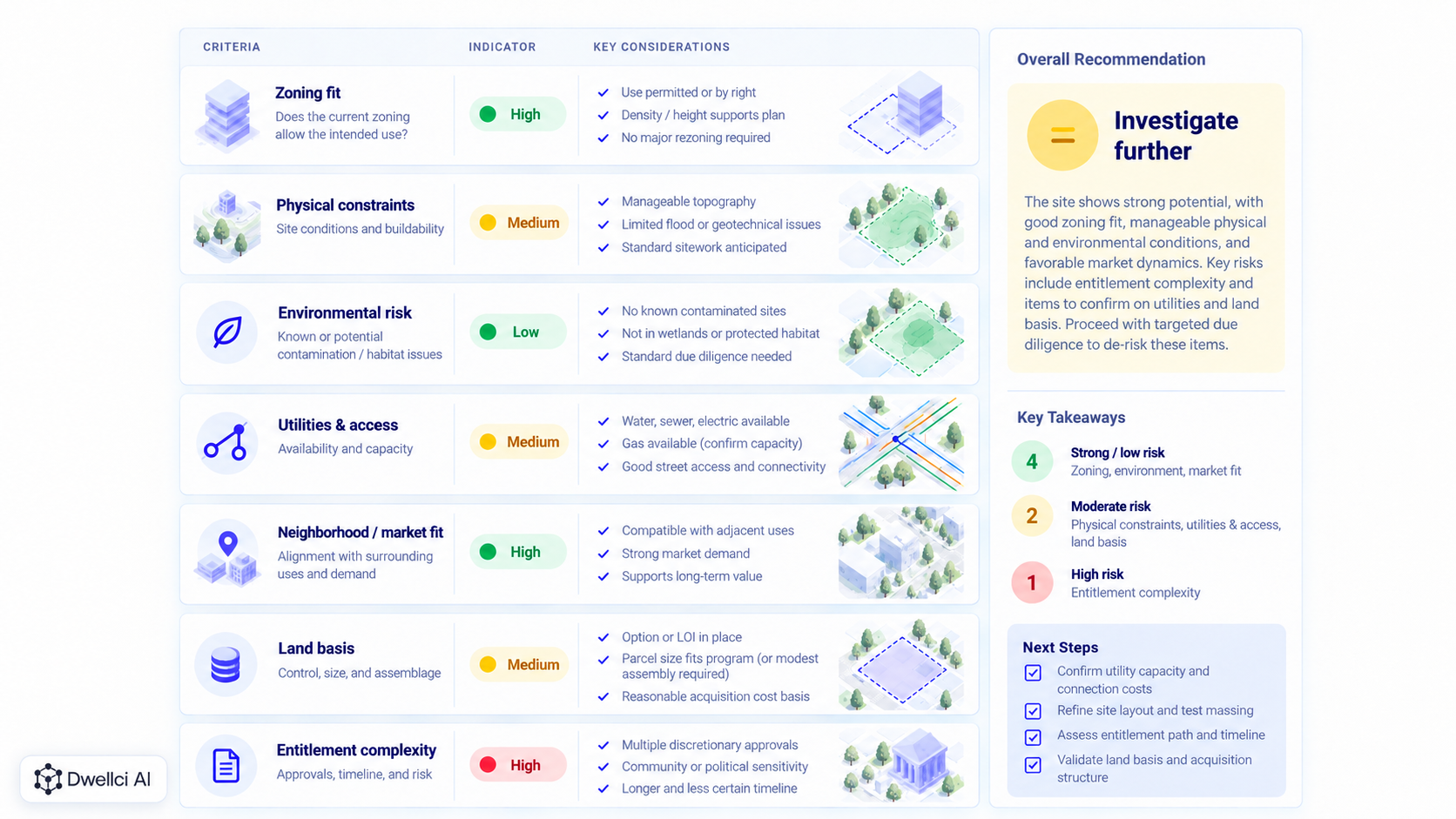
Some findings should immediately move a site from simple screening into deeper diligence.
Examples include a proposed use that is not clearly permitted, unusual parcel geometry, major flood exposure, suspected wetlands, historical industrial use, uncertain access, apparent easements, conflicting public records, a difficult parking requirement, or a development program that only works under an aggressive interpretation of the zoning rules.
None of these conditions automatically disqualifies a property.
They change the questions the acquisition team should ask before committing capital.
Dwellci AI is designed to help development teams evaluate opportunities during this early phase.
The platform brings parcel intelligence, zoning analysis, site constraints, property comparison, and zoning-backed 3D feasibility into one workflow so teams can understand development potential before significant capital or design effort is committed.
The goal is not to replace attorneys, architects, engineers, surveyors, environmental professionals, or other specialists.
It is to help acquisition teams identify the sites—and the questions—that deserve deeper professional diligence.
At a minimum, review the parcel, intended use, zoning, density and dimensional controls, site constraints, access, utilities, flood and environmental conditions, and whether a realistic development scenario can fit on the property.
No. Zoning is an important layer, but development risk can also come from title, access, utilities, environmental conditions, easements, flood exposure, physical site conditions, and other property-specific issues.
Professional involvement depends on the site and project. Early screening can help identify the questions that require architectural, engineering, legal, environmental, survey, or other specialized review before acquisition.
At the screening stage, test preliminary land basis, construction and soft costs, financing, schedule, rents or sale values, contingency, and the effect of downside changes in yield, timing, or site work. The goal is not a final underwriting model; it is to identify whether the deal is unusually sensitive to assumptions that still need verification.
Site screening is an early process for identifying development potential and major risks quickly. Formal due diligence is deeper and may include legal, environmental, engineering, survey, title, financial, and entitlement investigations.